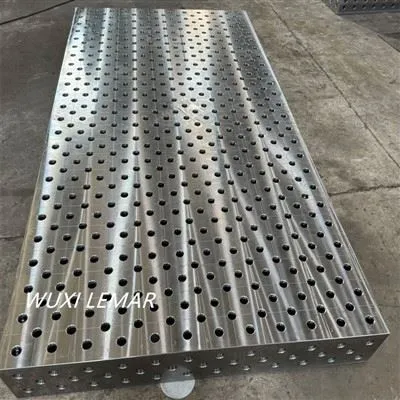
I. Ensuring Welding Accuracy and Workpiece Consistency
The flatness of the 3D welding table, as a "process reference surface," directly affects the positioning accuracy of the workpiece. If the flatness exceeds tolerance, it will lead to:
Instable workpiece installation, resulting in elastic deformation after clamping;
Weld seam misalignment and uneven lap gaps, affecting weld strength;
Inaccurate reference during multi-process retesting, causing cumulative errors.
Regular inspections can promptly detect minor deformation trends, preventing batches of workpieces from being scrapped due to inaccurate references.
II. Preventative Maintenance, Reducing the Risk of Sudden Downtime
High temperatures, vibrations, and heavy loads during welding can easily trigger stress release within the platform, leading to slow deformation. Through systematic quarterly inspections, a "flatness change trend file" can be established, enabling a shift from passive maintenance to proactive intervention.
✅ For example: If the flatness change in a single quarter is >0.02mm/1000mm, it indicates active internal stress, requiring advance vibration aging treatment.
III. Extend Equipment Lifespan and Control Long-Term Costs
While cast iron platforms (such as the HT300) offer high stability, they can still deform over extended use. Regular inspections combined with professional calibration (such as scraping and CNC milling) can effectively restore accuracy and avoid the need for complete machine replacement.
⚠️ Neglecting inspections can lead to minor deformations developing into irreversible damage, increasing repair costs by 3-5 times.
IV. Meet Industry Standards and Quality Certification Requirements
Aerospace, automotive manufacturing, and other fields have clear specifications for the precision of process equipment. For example:
National Standard GB/T22095-2008 sets graded requirements for the flatness of cast iron plates;
ISO 8512-1 specifies methods for testing the geometric accuracy of machine tool worktables.
Regular inspections not only ensure compliance but also provide data support for quality traceability.
V. Improve Production Efficiency and Process Stability
When multiple workstations share the same reference system, inaccuracies in the flatness of the main worktable can trigger a chain reaction of problems. Regular inspections can:
Quickly pinpoint the source of anomalies;
Avoid wasting time on repeated fixture adjustments;
Ensure the trajectory accuracy of automated production lines (such as welding robots).
📌 Recommendation: Use electronic levels or coordinate measuring machines for inspections, archive the data, and generate visual trend charts for easier management and decision-making.