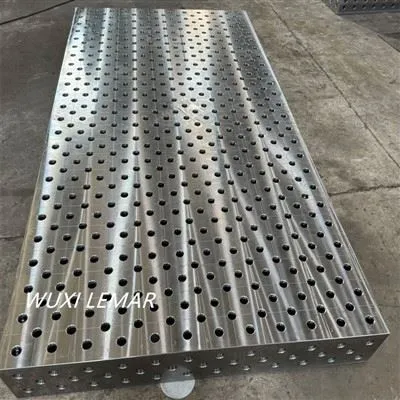
I. Hole System Consistency Acceptance Criteria
Hole system consistency requires that the accuracy deviation of all holes remain uniform. The acceptance criteria are as follows:
The hole diameter tolerance at any position is consistently within the D10 grade requirement range, with a deviation fluctuation not exceeding 0.02mm.
The center distance error between any two adjacent holes is ≤±0.05mm, and the center distance deviation fluctuation between holes in different areas is ≤0.03mm.
The fit between all locating pins and any hole is consistent, with no cases of some holes being too tight or others too loose.
II. On-site Inspection and Judgment Methods
1. Rapid Inspection Method Without Professional Equipment (Most Commonly Used)
✅ Full Area Module Interchange Test
Select 3-5 locating modules and install them sequentially into the holes in the four corners, center, and edge areas of the work surface. Observe the fit:
Pass: Modules in all areas can be installed smoothly, with consistent tightness after positioning, no obvious shaking, and no individual holes that cannot be installed or are stuck.
Fail: Some holes cannot be installed, modules are stuck during insertion, or the shaking amplitude after installation is significantly greater than other holes, indicating poor consistency.
✅ Repetitive Positioning Deviation Test: Fix the same standard workpiece in different areas of the worktable. Repeat the repositioning and disassembly process 5 times in each area, and measure the positional deviation of the workpiece's reference surface.
Pass: Repeatable positioning deviation in all areas is ≤0.05mm, and the deviation difference between different areas does not exceed 0.03mm.
Fail: Positioning deviation difference between different areas exceeds 0.05mm, indicating that the hole system consistency is substandard.
2. Professional Precision Inspection Method (Recommended for Acceptance of New Equipment)
Use a coordinate measuring machine for random inspection:
Select at least 10 holes at different locations on the four corners, center, and edges of the worktable.
Measure the hole diameter, center distance, and perpendicularity of each hole.
Calculate the deviation range of all test results. A range ≤0.05mm indicates acceptable consistency; a range exceeding 0.1mm indicates poor consistency, classifying the product as unqualified.
III. Impact of Poor Hole System Consistency: Poor hole system consistency leads to inconsistent workpiece positioning accuracy in different areas, resulting in large dimensional errors in the workpiece after welding, reduced module versatility, and directly impacting welding quality and production efficiency. Therefore, it is crucial to conduct thorough testing during procurement.