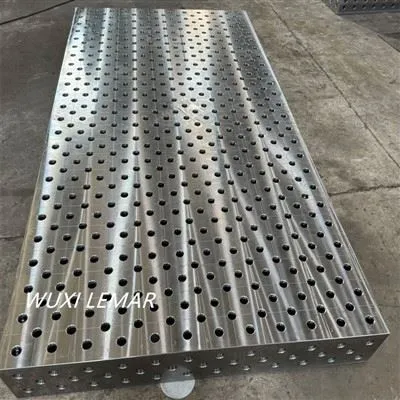
I. Determine the stage of development by layering corrosion morphology
1. Initial Corrosion: Surface oxidation, still reversible
Characteristics: Dark spots, dullness, or slight grayish-white discoloration appear on the work surface, losing its original metallic luster; under strong light, a "water film" or "sweat beads" are visible.
Tactile Feedback: A slight astringent feeling when sliding fingers; a light yellowish-brown trace remains after wiping with a cotton cloth.
Risk Warning: At this stage, a substantial oxide layer has not yet formed. If treated within 48 hours, it can be completely restored without affecting accuracy.
✅ Applicable Scenarios: Uneven table surface color found during routine inspections or failure to apply oil promptly after machine shutdown.
2. Intermediate Corrosion: Localized oxide layer formation, affecting fit
Characteristics: Reddish-brown or orange-yellow spots appear on the edges of positioning holes and T-slots; powdery rust is visible inside the holes; the anti-spatter coating peels locally, and the base color changes.
Tactile Feedback: The positioning pin is difficult to insert and requires gentle tapping to reach its proper position; the brush head carries out reddish-brown powder during hole cleaning.
Risk Warning: This has affected hole spacing tolerance and repeatability accuracy, potentially leading to robot welding path deviation or fixture loosening.
✅ Applicable Scenarios: High usage frequency, infrequent cleaning, or lack of enhanced protection during the rainy season.
3. Severe Corrosion: Deep oxidation, structural risks revealed.
Characteristics: Rust spots expand in patches, surface is rough, and localized pits or pockmarks form; in severe cases, the rust layer peels off, exposing the substrate.
Tactile Feedback: Noticeably grainy or scratchy feel; difficult to clean with a copper brush; high resistance during electric hole cleaner operation.
Risk Warning: May lead to flatness deviations (>0.1mm/m), requiring machine shutdown for scraping or machining repair, affecting production continuity.
✅ Applicable Scenarios: Long-term lack of maintenance, continuous shutdown without protection, or excessively high ambient humidity.
II. Establishing Actionable Judgment Standards Based on Quantitative Indicators
To avoid subjective misjudgment, it is recommended to refer to the following quantitative thresholds for evaluation:
1. Rust Area Percentage: If the total rust area exceeds 5% of the working surface, it is considered moderate to severe rust and requires immediate treatment.
2. Hole Corrosion Depth: Using an endoscope or ultrasonic thickness gauge, if the oxide layer depth is ≥0.1mm, it indicates deep corrosion.
3. Surface Roughness Change: If the original Ra≤1.6μm, and the measured value increases to Ra≥2.5μm, it can be considered severe rust, affecting clamping stability.
4. Positioning and Fit Clearance: Measured with a mandrel and dial indicator, if the insertion resistance causes a displacement deviation >0.05mm, it indicates that the hole system is out of alignment.
These indicators can be included in the daily inspection checklist to achieve "data-driven" rust assessment.
III. Environmental and Usage-Related Predictive Measures
Even if there are no obvious rust spots on the surface, the following situations should raise a high level of vigilance:
1. During the rainy season (June-July) in Wuxi, air humidity often exceeds 80%. Cast iron platforms (such as the HT300) are highly susceptible to moisture absorption. It is recommended to conduct a comprehensive rust inspection at least once a month.
2. If equipment has not been used for more than 7 consecutive days and has not been coated with oil, even if it appears normal, it should be considered a potential rust risk.
3. Failure to promptly clean welding slag and oil stains after use will result in the residue absorbing moisture and creating an electrolyte environment, accelerating electrochemical corrosion.
🔍 Special Reminder: When there are large temperature differences between day and night, the "breathing effect" of the platform will draw in moist air and condense, which is a major cause of hidden rust.