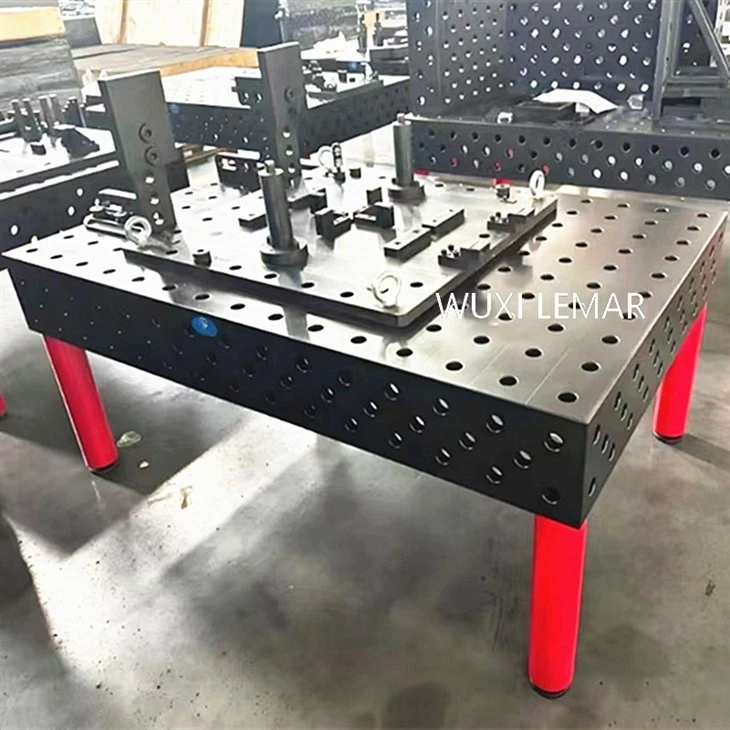
1. Use clamps and positioning devices
Clamping: Use clamps to securely secure the workpiece to the workbench. Clamps can be manual, pneumatic, or hydraulic; the appropriate clamp type should be selected based on the workpiece's shape and size.
Location blocks and support blocks: Use location blocks and support blocks to position the workpiece in the correct position. Location blocks ensure alignment, while support blocks provide additional support to prevent deformation caused by thermal stress during welding.
Welding fixture systems: For complex workpieces, specialized welding fixture systems can be used. These systems typically include multiple clamps and positioning elements, capable of simultaneously securing multiple workpieces.
2. Optimizing the welding process
Preheating the workpiece: Preheating the workpiece before welding can reduce thermal stress caused by temperature fluctuations during welding, thereby reducing the risk of workpiece displacement.
Controlling welding parameters: Properly set welding current, voltage, and welding speed to avoid excessive heat input that could cause workpiece deformation or displacement. Using welding methods with low heat input, such as TIG welding, can reduce thermal stress. Segmented Welding: For longer welds, a segmented welding method can be used, starting with the center of the weld and then gradually working toward the ends. This method can reduce workpiece deformation caused by thermal stress during welding.
3. Use a 3D Welding Table
High-Precision Positioning Holes: The 3D welding table has regular holes machined on all five sides (such as a 100×100mm or 50×50mm grid), allowing workpieces to be precisely positioned and secured to the table using positioning blocks and clamps.
Modular Design: The modular design of the 3D welding table allows users to quickly adjust and configure the table based on the shape and size of the workpiece, adapting to varying welding requirements.
Sturdy and Durable Construction: The table is typically constructed of cast iron or steel and undergoes special processing to provide high load-bearing capacity and deformation resistance, enabling it to withstand the high stresses of welding.
4. Use Anti-Deformation Devices
Anti-Deformation Clamps: Using anti-deformation clamps can effectively prevent workpiece deformation caused by thermal stress during welding. These clamps are often designed with special structures to provide additional support during welding. Anti-deformation measures: Before welding, anti-deformation treatment of the workpiece is performed. This involves applying a force opposite to the welding deformation, effectively reducing post-weld deformation.
5. Real-time monitoring and adjustment
Vision system: A 3D vision system monitors the workpiece position during welding in real time. If workpiece displacement is detected, welding parameters can be adjusted or the workpiece can be repositioned immediately.
Automated welding system: For complex welding tasks, automated welding systems, such as robotic welding, can be used. These systems use vision systems and sensors to adjust the welding path and parameters in real time, ensuring welding accuracy.
6. Operator skills and experience
Professional training: Ensure that operators receive professional welding training and are familiar with the operating procedures and safety regulations of the welding equipment.
Experience: Operator experience is also crucial in preventing workpiece displacement. Experienced operators can take appropriate measures to prevent workpiece displacement based on the workpiece shape, material, and welding requirements.