

When it comes to installing a steel welding table for a robot, understanding the space requirements is crucial. As a supplier of Steel Welding Tables For Robot, I've encountered numerous clients with various questions regarding the appropriate space for these essential pieces of equipment. In this blog, I'll delve into the key factors that influence the space needed for installing a steel welding table for a robot and provide some practical guidelines.
Factors Affecting Space Requirements
Robot's Working Envelope
The first and most significant factor is the robot's working envelope. The working envelope is the three - dimensional space within which the robot can move its end - effector. It is determined by the robot's arm length, joint ranges of motion, and any additional reach provided by its base or mounting configuration.
For example, a six - axis industrial robot with a long reach will have a larger working envelope compared to a smaller, more compact robot. When installing a steel welding table, the table must be positioned entirely within the robot's working envelope to ensure that the robot can access all parts of the workpiece. This means that the length, width, and height of the welding table should be considered in relation to the robot's ability to reach every point on the table surface.
Safety Clearances
Safety is of paramount importance in any industrial setting. Adequate safety clearances must be maintained around the steel welding table and the robot. These clearances are necessary to prevent accidents, allow for maintenance access, and comply with safety regulations.
A general rule of thumb is to have a minimum clearance of at least 1 - 2 meters around the perimeter of the welding table. This space allows operators to safely approach the robot and the table during non - operational periods for tasks such as loading and unloading workpieces, tool changes, and maintenance. In addition, height clearances are also crucial, especially if the robot has a vertical reach that extends above the table. A clearance of at least 2 - 3 meters above the table is often recommended to prevent the robot from hitting any overhead obstacles.

Auxiliary Equipment
Steel welding tables for robots are often used in conjunction with various auxiliary equipment such as welding power supplies, gas cylinders, wire feeders, and coolant systems. These pieces of equipment also require space for installation and operation.
Welding power supplies, for instance, need to be placed in a well - ventilated area to prevent overheating. Gas cylinders should be stored in a secure location, away from heat sources and potential ignition hazards. Wire feeders usually need to be positioned within easy reach of the robot to ensure smooth wire feeding during the welding process. All these auxiliary equipment should be arranged in a way that does not impede the robot's movement around the welding table.
Space Requirements for Different Types of Steel Welding Tables
3D Modular Fixture Welding Table
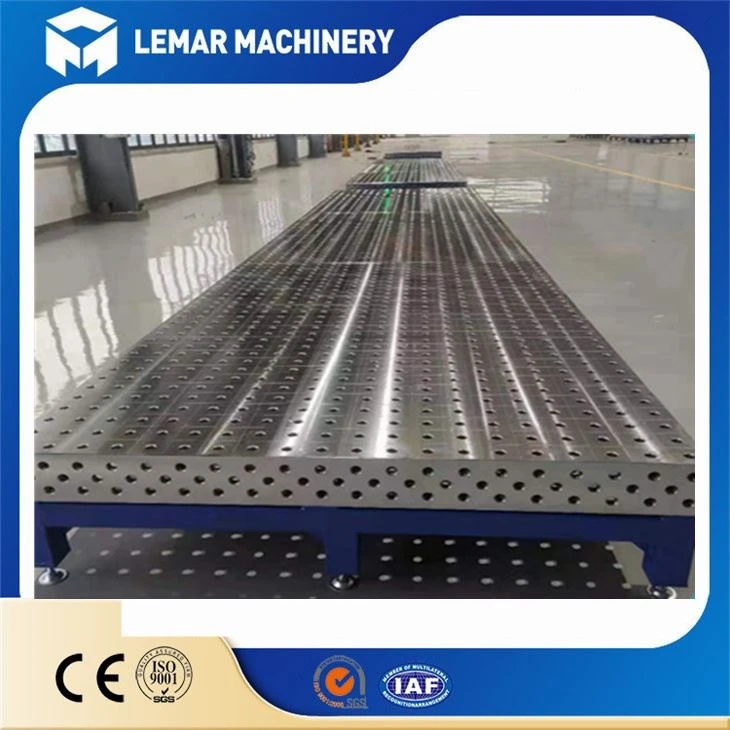
3D modular fixture welding tables are highly versatile and can be configured to suit different welding applications. They typically have a larger footprint compared to 2D tables due to their three - dimensional structure and the ability to accommodate complex fixtures.
The space required for a 3D modular fixture welding table depends on its size and the number of fixtures it can hold. A small - scale 3D table may require a floor space of around 3 - 5 square meters, while a large industrial - grade table could need 10 square meters or more. Additionally, the height of the table and the fixtures must be considered to ensure that the robot has enough vertical clearance to operate.
Nitriding Treatment 3D Welding Table
Nitriding treatment 3D welding tables offer enhanced surface hardness and wear resistance. These tables often come with a more robust design and may be larger in size to support heavy - duty welding operations.
Similar to 3D modular fixture welding tables, the space requirements for nitriding treatment 3D welding tables are influenced by their dimensions and the complexity of the workpieces they are designed to handle. The additional nitriding treatment chamber or associated equipment may also need some extra floor space for installation and maintenance.
Special Welding Table
Special welding tables are designed for specific welding tasks or applications. They can vary greatly in size, shape, and functionality. For example, a welding table designed for welding large - scale components may be much larger than a table for small - scale precision welding.
When installing a special welding table, it is essential to carefully assess the space requirements based on the specific features of the table and the robot's requirements. Some special welding tables may have additional features such as tilting or rotating mechanisms, which will require more space for their operation.
Welding Table Diagonal Holes
Welding tables with diagonal holes are designed to provide more flexibility in fixture placement. These tables can be used in various welding operations, but their space requirements are similar to other standard welding tables of comparable size.
The main consideration for wiring tables with diagonal holes is the ease of access for the robot to the holes for fixture installation. The space around the table should be sufficient to allow the robot to move its end - effector to the diagonal holes without any obstruction.
2D Flexible Welding Table
2D flexible welding tables are suitable for flat - surface welding applications. They are generally more compact compared to 3D tables but still require adequate space for the robot to operate.
The space required for a 2D flexible welding table depends on the size of the table and the reach of the robot. A small - to - medium - sized 2D table may need a floor space of 2 - 4 square meters, while larger tables may require 5 - 8 square meters. The height clearance above the table should also be sufficient to ensure that the robot can perform the welding operations without any interference.
Practical Guidelines for Space Planning
Measure Twice, Install Once
Before installing a steel welding table for a robot, it is essential to accurately measure the available space in the workshop. This includes the floor area, ceiling height, and any existing obstacles such as columns or machinery.
Create a detailed layout plan that shows the position of the welding table, the robot, and all the auxiliary equipment. Use scale drawings or 3D modeling software to visualize the installation and ensure that there is enough space for everything.
Consider Future Expansion
When planning the space for a steel welding table and robot, it is a good idea to consider future expansion. As your business grows, you may need to upgrade the robot or add more welding tables.
Leaving some extra space around the installation area will make it easier to accommodate future changes without having to undergo a major re - arrangement of the workshop.
Conclusion
In conclusion, the space requirements for installing a steel welding table for a robot are determined by several factors, including the robot's working envelope, safety clearances, and the presence of auxiliary equipment. Different types of welding tables, such as 3D modular fixture welding tables, nitriding treatment 3D welding tables, special welding tables, welding tables with diagonal holes, and 2D flexible welding tables, also have their own unique space requirements.
By carefully considering these factors and following the practical guidelines for space planning, you can ensure a safe and efficient installation of your steel welding table and robot system. If you are interested in purchasing a high - quality steel welding table for your robot, feel free to contact us for further discussions and procurement opportunities. We are more than happy to help you find the most suitable solution for your specific needs.